All Posts By

BankLabs

Loan Participations and Loan Sales Guide Cover

The Complete Guide to Loan Participation, Loan Sales, and Loan Syndications for Banks

By Article, Insights

If you’re a banker trying to keep lenders lending while managing concentration risk, liquidity pressure, and staffing constraints, you’ve probably bumped into the same bottleneck: the “capital markets” tools you need (loan participations, loan sales, syndications) are often run on spreadsheets, email, and manual reconciliation.

That works—until it doesn’t. As volumes rise, portfolios diversify, or participants expand, the operational drag and “out-of-balance” risk climb fast. And when the process is heavy, the business outcome is predictable: fewer sell-downs, fewer partners, slower closings, and missed opportunities.

This guide breaks down how loan participation (plus syndications and whole-loan sales) actually work, why they matter right now, and what a modern bank should look for if you’re evaluating tools to do this at scale.


Key takeaways

  • Loan participation lets you share a single loan’s exposure while keeping the borrower relationship with the lead lender—great for lending limits, concentration risk, and liquidity planning.

  • Loan syndication typically forms a lender group at origination under a common structure—useful for larger deals and shared underwriting at close.

  • Whole-loan sales transfer the entire loan to another party—often used for liquidity, balance sheet repositioning, or portfolio strategy.

  • Regulators expect buyers to underwrite and administer purchased loans/participations as if originated by the buyer—and caution against over-reliance on sellers.

  • The banks that win here treat participations as a repeatable operating system, not a one-off legal project.


Want a faster, safer way to run loan participations and loan sales? Explore how Participate (a BankLabs innovation) helps banks automate workflows, participant servicing, and reporting—without living in spreadsheets.
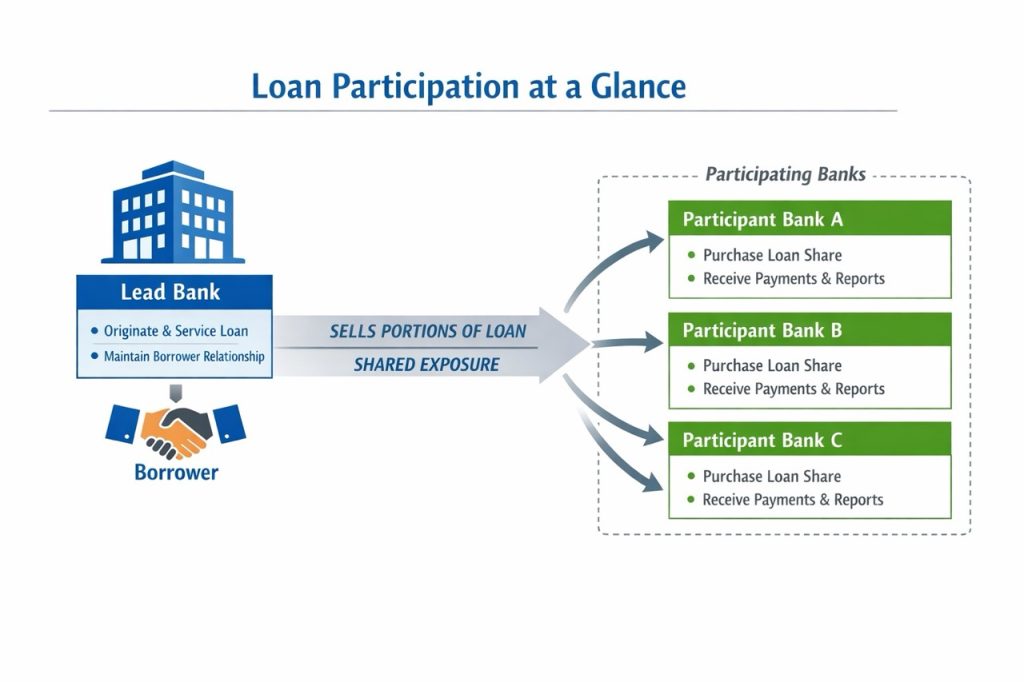

Loan participation structure showing lead bank, participants, and shared exposure while the lead retains borrower relationship.

Loan participation structure showing lead bank, participants, and shared exposure while the lead retains borrower relationship.


What is a loan participation?

A loan participation is when the originating (lead) bank sells a portion of a loan to one or more participating institutions, while typically retaining the borrower relationship and servicing role.

Why banks use loan participations

Most banks use loan participations to:

  • Stay within legal lending limits while keeping the client relationship

  • Reduce concentration risk (borrower, industry, geography, tenor)

  • Improve liquidity flexibility by selling down exposure

  • Generate fee income via servicing/administration in many structures

  • Build reciprocal partner networks (send deals, receive deals)

Loan participation vs. “just buying a loan”

From a workflow standpoint, participations can look like “loan buying,” but they introduce ongoing operational complexity:

  • Shared balances must remain aligned

  • Payments/fees/rate changes need accurate allocation

  • Reporting and notices go to multiple institutions

  • Documents must be controlled and auditable

Expert tip: If your team says “we reconcile it at month-end,” you’re carrying unnecessary operational and reputational risk—because participant confidence erodes long before month-end.


Loan participation vs. loan syndication vs. whole-loan sale

Here’s a practical way to choose the right structure.

1) Loan participation (most common for many community/regional use cases)

Best when you want to:

  • Keep the borrower relationship

  • Sell down exposure post-close or near-close

  • Work with a small group of known partner banks

  • Maintain speed and flexibility

2) Loan syndication (common for larger, structured deals)

Best when you need:

  • Multiple lenders committed at origination

  • A clearer “agent/arranger” structure

  • Formal coordination across the lender group

  • Standardized communications and consent mechanics

3) Whole-loan sale (clean transfer)

Best when:

  • You want full liquidity relief

  • You’re repositioning a portfolio

  • A buyer wants full ownership/control

  • You want to simplify ongoing administration (because you no longer service)


Why loan participations matter more right now (and what regulators are signaling)

Balance sheets have been under pressure: liquidity planning, credit normalization, and concentration scrutiny are not theoretical—they’re daily management issues.

Regulators have been explicit that when institutions purchase loans or participations, they should manage them with the same rigor as originated assets and avoid over-reliance on lead institutions or third parties.

The OCC similarly frames loan purchase activities (including participations and participations in syndicated loans) as long-standing practices that must align with strategy, risk appetite, and strong due diligence/credit administration.

Did you know? The FDIC updated its advisory (amended February 3, 2026) to remove references to reputation risk—while keeping the core expectations around independent underwriting, administration, and third-party risk.


The real bottleneck: operations, not opportunity

Most banks don’t struggle with why to do participations—they struggle with how to do them repeatedly without friction.

Common pain points in traditional loan participation workflows

  • Manual “system of truth” issues (multiple spreadsheets, versions, email chains)

  • Out-of-balance risk between lead and participants

  • Slow participant communications (rate changes, payments, remittance notices)

  • Document sprawl (attachments, unsecured sharing, scattered files)

  • Limited visibility for leadership (portfolio analytics, performance reporting)

  • Scaling constraints (volume increases require headcount increases)

This is exactly why automated platforms are showing up in bank operating models: not to “innovate for innovation’s sake,” but to make participation activity repeatable and auditable.
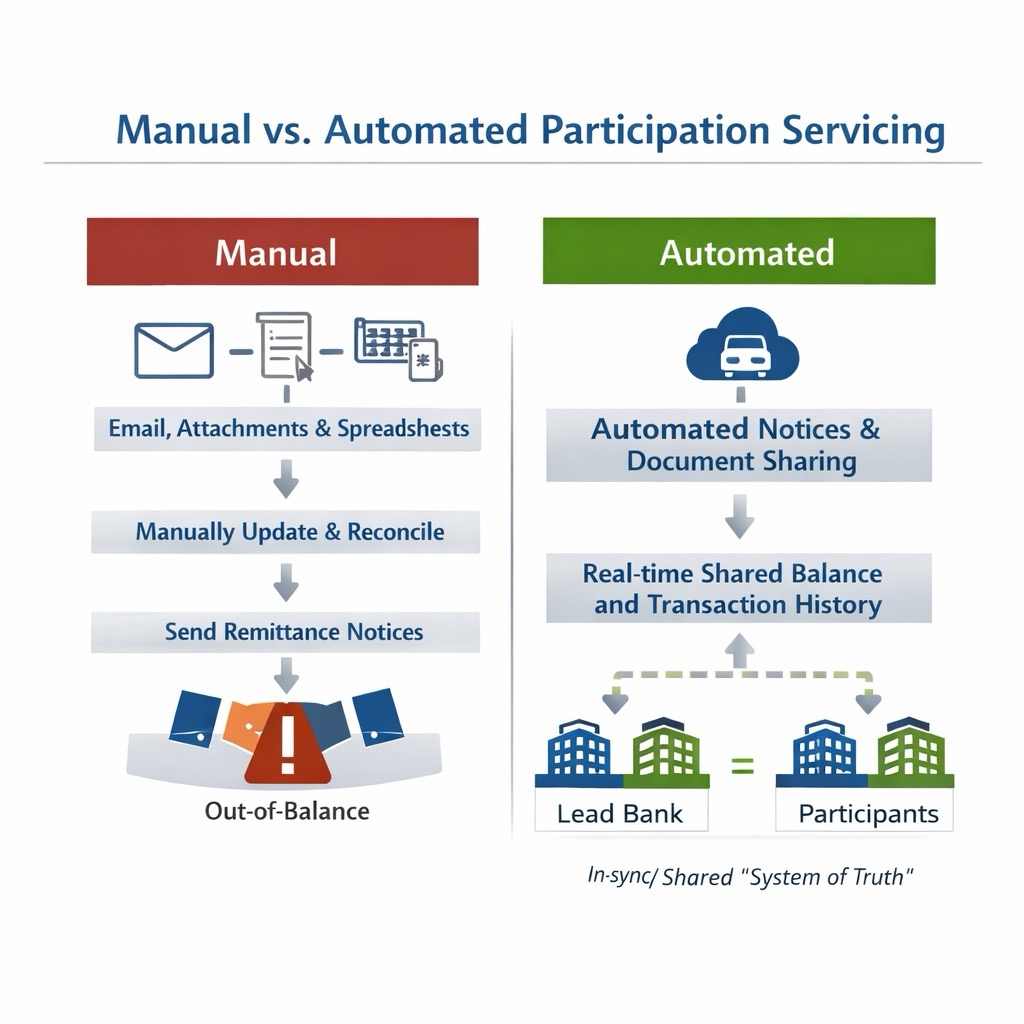

Side-by-side workflow comparing spreadsheet/email processes to automated servicing with real-time balances and automated notices.

Side-by-side workflow comparing spreadsheet/email processes to automated servicing with real-time balances and automated notices.


What “loan participation automation” actually means

When bankers hear “automation,” they sometimes imagine a rip-and-replace, loan participation automation actually means:

A) A standardized workflow for selling down and onboarding participants

  • Publish the opportunity (internally or to approved partners)

  • Secure document sharing + approvals

  • Built-in NDAs/participation agreement workflow (or your own templates)

  • Track status and commitments

B) Ongoing participant servicing without manual reconciliation

  • Automated payment splits (principal/interest/fees)

  • Automated rate change notices

  • Shared balances and transaction history

  • Centralized documents + audit trail

C) Reporting and visibility that helps you scale

  • Buy-side / sell-side dashboards

  • Portfolio analytics

  • Board-friendly reporting

  • Exception-based operations rather than “touch everything”

Expert tip: Ask vendors one blunt question: “Who is the system of truth when our core and our participants disagree?” The best answers include shared balances + traceable transaction history.


A buyer-centric checklist: what to look for in a loan participation tool

If you’re evaluating solutions (or even building internally), here’s a practical checklist.

Workflow + speed

  • Can you package and share an opportunity in minutes, not days?

  • Can you control distribution (specific partners vs. broader network)?

  • Can you track approvals and commitments without chasing email?

Servicing + controls

  • Do participants see the same balance and history you see?

  • Are rate changes and notices automated?

  • Is reconciliation built into the process (or offloaded to month-end)?

Data + integrations

  • Can it integrate with your LOS/core (or start quickly without deep integration)?

  • Does it support the data elements you care about (loan terms, covenants, reporting)?

  • Can you onboard existing participations to get value immediately?

Risk + compliance alignment

  • Secure document handling and permissioning

  • Audit trail and approvals

  • Clear third-party risk management support (SOC posture, access controls, etc.)


Where Participate fits

Loan participations and loan sales are powerful tools — but without the right operating structure, they become operationally heavy.

As participation volume grows, spreadsheets, manual notices, and reconciliation work can limit scalability. What starts as a strategic advantage can quickly turn into administrative drag.

Participate, developed by BankLabs, is built to serve as the operating layer for loan participations, syndications, and loan sales. It standardizes workflow, automates participant servicing, and creates real-time balance transparency between originators and participants.

With the right system in place, banks can:

  • Automate deal workflow and participant onboarding

  • Maintain real-time shared balances

  • Eliminate reconciliation friction

  • Centralize documentation and reporting

  • Scale participation activity without scaling headcount

The outcome is simple: more confidence, less operational risk, and a repeatable framework for growing your loan sales ecosystem.


FAQ

What is the difference between a loan participation and a loan syndication?
A loan participation typically involves a lead lender selling portions of a loan (often after origination) while keeping the borrower relationship. A syndication usually forms a lender group at origination under a coordinated structure (often with an agent/arranger).

Can smaller banks benefit from loan participations?
Yes. Participations allow smaller institutions to access larger deals, diversify portfolios, and manage exposure more effectively.

How do loan participations help with concentration risk?
They let you sell down exposure by borrower/industry/geography/tenor while keeping the client relationship and continuing to originate new business.

What’s the biggest operational risk in participations?
“Out-of-balance” conditions and incomplete information sharing—especially around payments, rate changes, fees, and document versions. That risk grows with volume and participant count.

Can we modernize without a massive integration project?
Yes, with Participate you can go live in less than 24 hours. Many banks start by standardizing workflow and servicing visibility first, then expand integrations over time based on ROI and operational readiness.


Conclusion

Loan participations, syndications, and loan sales aren’t niche tools—they’re core levers for balance sheet strategy, risk management, and growth. The difference between “we do participations occasionally” and “we do participations confidently” is almost always the operating model: visibility, controls, and repeatability.

If you want to turn loan participation activity into a scalable process—without adding headcount or living in reconciliation—explore Participate’s approach to workflow + servicing automation. Request a Free Demo.

CU broadcast podcast image

CU Broadcast Interview – SRP FCU’s Will Scott & BankLabs Matt Johnner

By Insights, Video Interview No Comments

We’re proud to work with credit unions like SRPFCU that prioritize taking care of members . Check out the latest episode of CUBroadcast to hear firsthand from Will Scott of SRP about his experience working with us and how his credit union has been able to grow: https://www.cubroadcast.com/episodes/1107-how-srp-fcu-has-used-banklabs-commercial-lending-technology-to-help-the-credit-union-grow

waves

CenterState Bank & BankLabs Win Innovation Award – Mobile Construction Loan Automation

By Award, Insights, Press Release No Comments

Little Rock, Ark., September 25, 2018 – BankLabs, a national provider of innovative mobile technology products for financial institutions, today announced that Fla.-based CenterState Bank has signed on for BankLabs’ cloud-based construction loan management product, Construct.

Construct is a banker-centric, web-based service that automates the post-close administration of construction loans for lenders. Accessible from any phone, tablet or computer, it eliminates the need for paper files and spreadsheets, increases bank productivity, mitigates the risk of overfunding projects and improves the experience for both the builder and borrower.

“We were in need of a modern and mobile approach to improve efficiency and consistency, while simultaneously improving the borrower experience and reducing risk with real-time reporting,” said Frances Mansour-Bergin, vice president and construction loan administration manager at CenterState Bank. “Construct has completely automated our loan administration, inspection and draw process, making a highly complex practice very quick and efficient. It has made processing construction loans easy for everyone involved, including the builders and borrowers.”

Construct has proven to reduce loan administration time by 50 percent, lower inspection costs, identify and mitigate potential risks and enhance the borrower/builder relationship through mobile access. Financial institutions using Construct have already seen an eight to 12 percent draw interest improvement, as well as a decrease in cycle time from days or weeks to minutes.

CenterState was recently recognized as a winner of the second annual Impact Awards through its usage of BankLabs’ solution. The awards, independently judged by Celent, identify organizations that are using technology or services in innovative ways to better serve their customers and drive tangible results. CenterState was acknowledged for its innovative construction lending solution.

“We are thrilled that CenterState is not only seeing improvements since implementing Construct, but that they are being recognized for those improvements,” said Matt Johnner, president and co-founder of BankLabs. “We are proud to partner with innovative financial institutions, like CenterState, that are ready to embrace change and mobility in the construction finance industry.”

About BankLabs

The mission of BankLabs is to reimagine banking products of the future through community-oriented technologies that create new fee income, attract deposits, expand loan opportunities and differentiate the financial institution from competitors. BankLabs believes that community banking is a way of doing business, not a size, location or traditional definition. For more information, visit banklabs.com.

Construtech 50 2018 logo

BankLabs Selected to Constructech 50 for 2018

By Award, Insights No Comments

BankLabs is honored to be named to Constructech’s Top 50 companies in 2018 for construction technology for our construction payment automation product, +Pay. This program recognizes the leading technology and software companies – from companies with a single offering to companies that may house multiple software or hardware platforms.

Our +Pay product is cloud-based and accessible from any mobile device or computer. It standardizes builders and general contractors payment process to improve efficiency, provide real-time data access and help their sub-contractors succeed.  Features include electronic payment requests from sub-contractors, including supporting lien waivers and invoices. The product automates 1099 tax reporting and provides fast and easy electronic payments to sub-contractors.


Tech 100 2018 logo

2018 HousingWire Tech100 Winner: BankLabs

By Award, Insights


BankLabs is honored to be named to Housing Wire’s 2018 Tech 100 List for our construction loan automation product, Construct. This program recognizes the leading technology and software companies – from companies with a single offering to companies that may house ten or more different software platforms.

Our Construct, cloud-based service automates the construction loan management process for community banks. It is accessible from phones, tablets or computers, and eliminates the need for paper files and spreadsheets, increases bank productivity, mitigates the risk of overfunding projects and improves the experience for the builder, borrower and inspector. Using Construct, a builder is able to view available funds via computer or mobile device and submit a draw request. Notifications are then sent via text or email to the inspector, borrower and bank personnel.

View the full list of winners here.

Banklabs logo

BankLabs Expands Operations in Arkansas

By Insights, Press Release

BankLabs Expands Operations in Arkansas with Support from Arkansas Economic Development Commission

BankLabs, a national provider of innovative mobile technology products for financial institutions, today announced that it is creating up to 19 full-time professional FinTech positions at its operations in Little Rock and is seeking highly qualified employees.

“Our goal is to differentiate the financial institutions that are not happy with the status quo from those that are resistant to change,” said Matt Johnner, president and co-founder of BankLabs. “Our clients want new ways to do things that leverage their strengths. BankLabs Chairman and CEO Mike Montgomery, has a rich history as a leader with Arkansas-based Systematics and Alltel Information Services. We both look forward to the next wave of innovation that BankLabs can help create.”

BankLabs seeks to grow the Arkansas economy into one that is focused on hi-tech, high-paying jobs, he said, and is pleased with the support from the Little Rock Regional Chamber of Commerce and Arkansas Economic Development Commission (AEDC) including tax credits and introductions to identify talented candidates.

“BankLabs is directly contributing to the resurgence of Arkansas as a FinTech leader,” said AEDC Executive Director Mike Preston. “The company is not only helping banks, but also creating FinTech marketplace options that expand business opportunities for everyone in the industry and across the globe. We are hopeful that the state’s support will not only help BankLabs grow its Little Rock team, but also help to improve the state’s economy.”

BankLabs recently added +Pay to its product offerings, automating the payment stream to sub-contractors from banks, general contractors, builders, title companies or disbursing agents. +Pay integrates seamlessly with BankLabs’ Construct product, which automates the residential and commercial construction loan process for banks and non-bank lenders. Together, they make the world’s first cloud-based vertically integrated construction finance platform.

“The expansion of BankLabs is another example of Little Rock’s growing FinTech industry,” said Little Rock Mayor Mark Stodola. “With our large banking presence and the 3rd VC FinTech Accelerator Powered by FIS occurring this summer at the Tech Park, the growing cluster of FinTech companies in Little Rock is now stronger than ever.”

Little Rock Regional Chamber of Commerce Board Chair Cathy Tuggle said, “We are excited to have an innovative company like BankLabs decide to continue its growth in the capital city. The Little Rock Technology Park and Venture Center have helped create a start-up environment where companies like BankLabs can flourish. This project is another wonderful example of our community’s entrepreneurial investment already succeeding.”

BankLabs is currently looking to fill highly paid professional product development and customer success positions in Arkansas. To apply, visit banklabsstaging.mystagingwebsite.com.

About BankLabs

The mission of BankLabs is to reimagine banking products of the future through community-oriented technologies that create new fee income, attract deposits, expand loan opportunities and differentiate the financial institution from competitors. BankLabs believes that community banking is a way of doing business, not a size, location or traditional definition. For more information, visit banklabsstaging.mystagingwebsite.com.

shaking hands

Establishing a Successful Partnership Between a Financial Institution and a Fintech

By Article, Insights

Establishing a Successful Partnership Between a Financial Institution and a Fintech

By Matt Johnner, president and co-founder of BankLabs 

As featured in William Mills Agency’s 2018 Bankers as Buyers Report.

Our society associates financial institutions with stability and trust, while fintechs typically epitomize change and innovation. These two opposing forces may seem to have very little in common, but that does not mean they can’t successfully work together to achieve a common goal.

According to PricewaterhouseCooper’s (PwC) 2017 Global Fintech Report, over 80 percent of financial institutions believe business is at risk to innovators. That may be true if the innovator is attempting to stand alone or replace financial institutions altogether. However, by partnering with a financial institution, innovators can work with a bank or credit union to solve an issue or meet a need.

Additionally, PwC reports that 82 percent of financial institutions expect to increase partnerships with fintechs in the next three to five years. This shows that financial institutions are willing to explore the innovative world of financial technology in order to provide better service to their customers, or scale a product outside of their traditional market.


Benefits of Partnerships between Financial Institutions and Fintechs

By partnering with a fintech provider, financial institutions improve upon the things they are already doing well. Technology can be used to solve an issue, update an existing process or enhance customer interactions. Fintechs have a lot to offer financial institutions, such as advanced, forward-looking technology and a fresh, outside perspective.

Of course, the partnership is just as beneficial to the fintech provider. Fintechs may hope to disrupt the industry by creating an unparalleled user experience, but solely focusing on this is not enough to be successful. A fintech provider without a financial institution to serve often ends up biting off more than they can chew.

With the implementation of a fintech service, financial institutions can differentiate themselves from other lenders in the space. By automating services and providing consumers with an innovative and efficient tool to make their lives easier, the financial institution becomes more competitive while also broadening their market. And, customers receiving a positive user experience from their bank or credit union will likely choose to stay with that bank or credit union.

A successful fintech partnership can also provide an additional revenue stream for the financial institution. Some fintechs can offer financial institutions modern, user-centric services that fulfill consumers’ needs while simultaneously charging a small fee on transactions that goes straight back to the financial institution. Think about how many paper checks still exist in unique industries or processes.


Tips to Create a Successful Partnership

Let’s start with an unsuccessful partnership; this is one that is created with the purpose of looking for a problem rather than solving one. A successful partnership begins when a fintech and a financial institution see a solution to an existing problem and need each other’s help in bringing that solution to life.

A smart fintech understands that a financial institution’s brand is extremely important to its success and cannot be jeopardized. Fintechs must approach potential partnerships with a thoughtful, conservative mindset. A failed fintech reflects poorly on the financial institution and its brand.

An equally important factor in a successful partnership is the financial institution ensuring its fintech provider has a strong background in banking. While fintechs offer unique, outside perspectives, they should also understand the fundamentals and the complexities of banking. The best fintechs have established bankers as part of their team or board of directors who understand the banking industry and the sanctity of its brand, needs and technology.

In addition, fintechs should leverage the financial institution’s existing products if speed to market and velocity is important. The solution must seamlessly integrate into the existing landscape and utilize the financial institution’s pre-existing product or distribution to solve a problem.

Lastly, open communication between the financial institution and fintech provider is key. The two should take part in an open discussion at the beginning of the partnership to determine goals and expectations. As previously mentioned, each party has a very different way of thinking, so it is imperative to discuss the definition of success early in the relationship.

It is important to remember that fintechs and financial institutions should not be competing with each other; they should be supporting each other. The best partnership is one in which both the parties achieve a goal that helps improve processes, reduce costs and enhance the user experience.

Matt Johnner is president and co-founder of BankLabs, a national provider of innovative, mobile technology products that help community banks improve efficiency, increase time for relationships with customers and create marketplace options that expand business opportunities. BankLabs believes that community banking is a way of doing business, not a size. For more information, visit banklabsstaging.mystagingwebsite.com.

American Banker logo

American Banker: As construction lending rebounds, tech investment follows

By Article, Insights

American-Banker-bank-labs-construction-lendingAs featured in American Banker.

As construction lending starts to make a comeback, many community banks relying on lending to developers and builders are looking to use cutting-edge digital interfaces to help them attract more clients.

“It’s important for us to create convenience not only for our clients but for their clients as well [such as subcontractors] and give them quicker and more convenient access to funds,” said David Veurink, chief credit officer and head of commercial banking at Chicago-based Countryside Bank.

Read More